106 OS homework 2-2 成果報告書
組長:B10415016、楊璿譯
組員:B10415039、曾柏誠
github: https://github.com/BryantTseng/xv6-public
🙂 使用情境說明(包含流程圖)
實作scheduling功能,共包含三種演算法:
- Round Robin(RR)
- First Come First Serve(FCFS)
- Priority
以下將針對此三種方法作使用情境之說明。
First Come First Serve(FCFS) Algorithm
當第一個process到來時,將先執行其需求,若同時有許多process可被服務(runnable),則選擇抵達時間最早的process執行,故其便無starvation的問題,因為每個process都將被執行到,但若先抵達的process,須執行時間較長,則會導致平均等待時間變長。

Priority Algorithm
scheduler將會給與每個process一個優先度,其會挑選優先度最高的先執行,執行完後挑次高的執行,若同時有優先度相同的process,則選擇到達時間低的執行。但此種方法便有可能發生satarvation,因為高優先度的process若可能被高頻率的呼叫,將會導致低優先度的process無法被執行,故會發生starvation。而我們解決方式為,process在完成任務便將priority-1,而同時若有process之優先度為1者則+1,這樣便可解決starvation的問題

Round Robin(RR) Algorithm
Scheduler將會定一段執行時間,規定每個process使用cpu資源時的時間長短,當規定時間一到便直接換下一個process使用,故不會有starvation的問題,雖然如此,但訂定執行時間須注意一些問題
- 當執行時間太短,會造成系統一直做 context switch,降低 CPU 的 Throughput
- 若將時間訂的太長, RR 便幾乎等於 FCFS。

😇 成功畫面
透過 GeneralTest 指令模擬出 CPU-bound 以及 I/O-bound 的process
然後分別用 Default(RR)、FCFS、Priority 三種不同的排程演算法執行
並觀察在不同的scheduler演算法下process的執行順序為何?
- Default (RR):
- 輸入GeneralTest測試指令

- Allocate出 10 個process
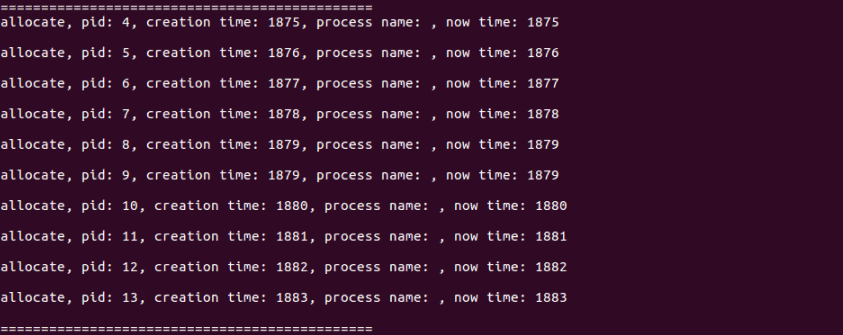
- 因為pid = 4的process為最早進來的,故最先做
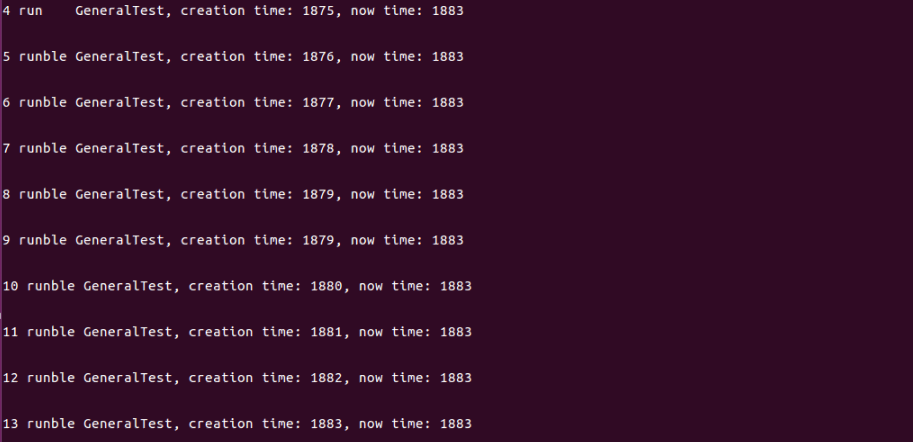
- 其次為pid = 5的process,故pid = 4在執行時間結束後須將CPU資源讓給pid 5使用
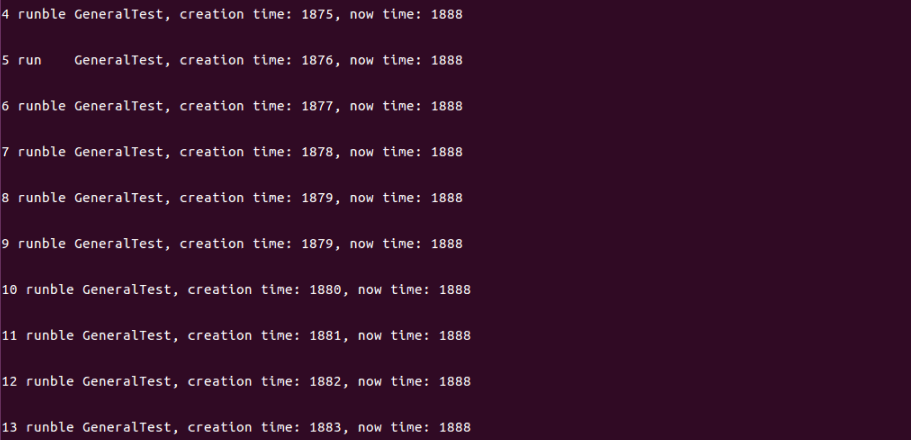
- 再來換pid = 6的process執行
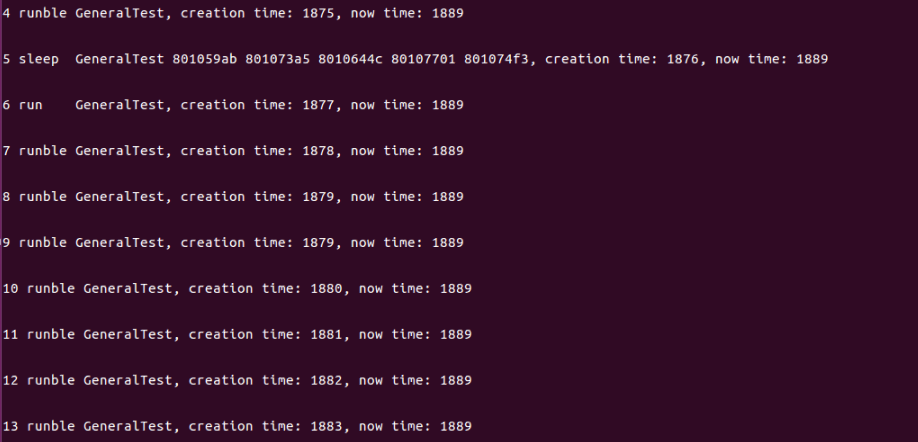
- 再來換pid = 7的process執行
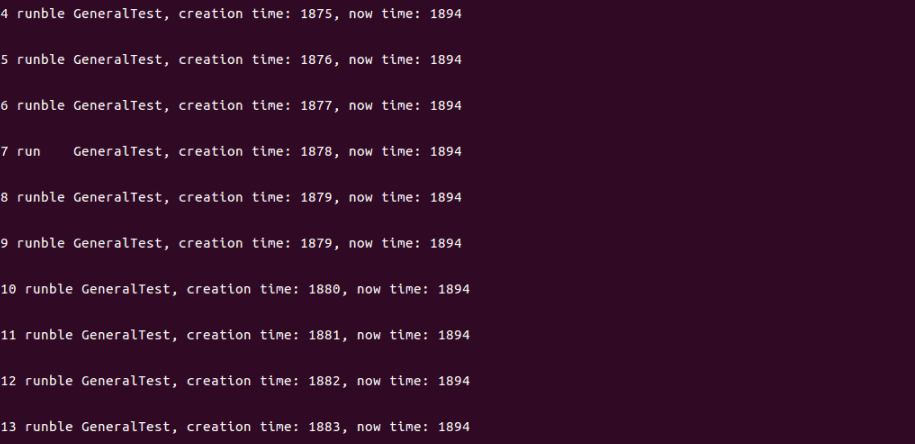
- 再來換pid = 8的process執行
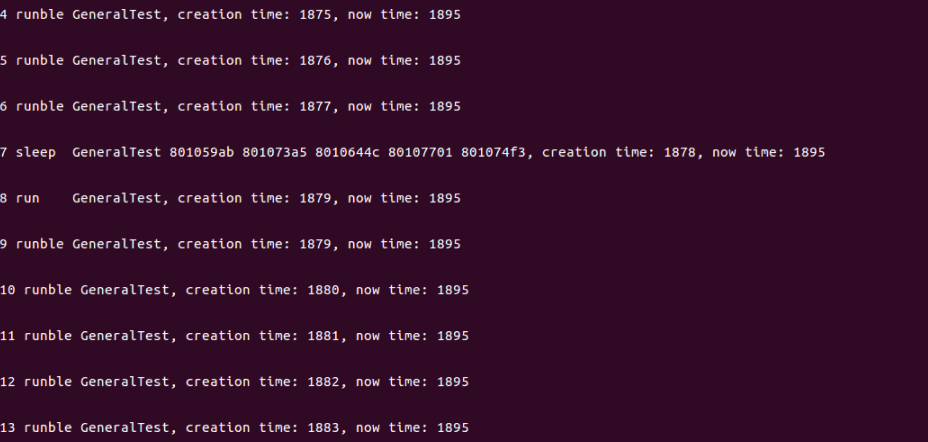
- 再來換pid = 9的process執行
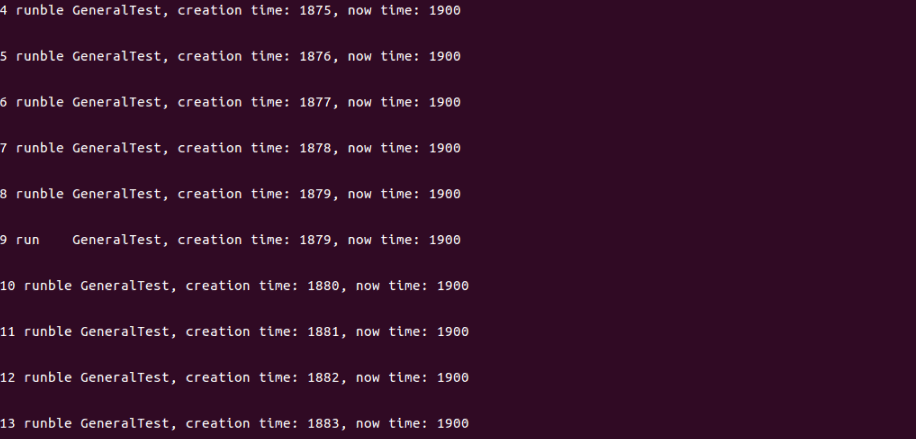
- 再來換pid = 10的process執行
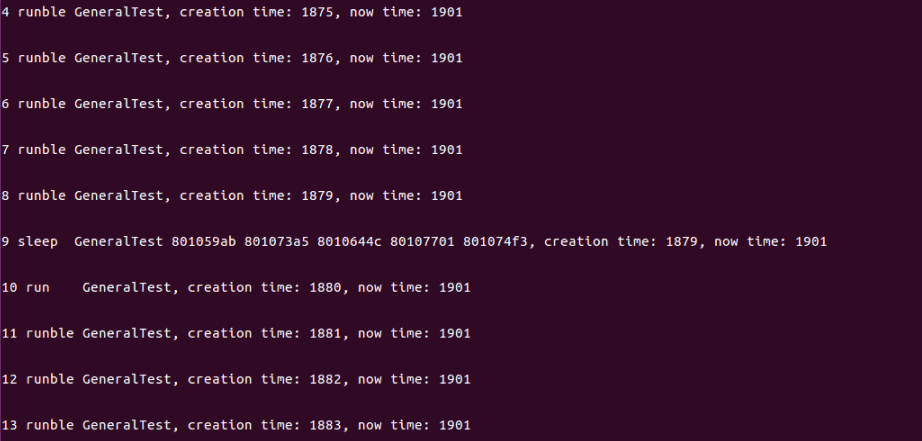
- 再來換pid = 11的process執行
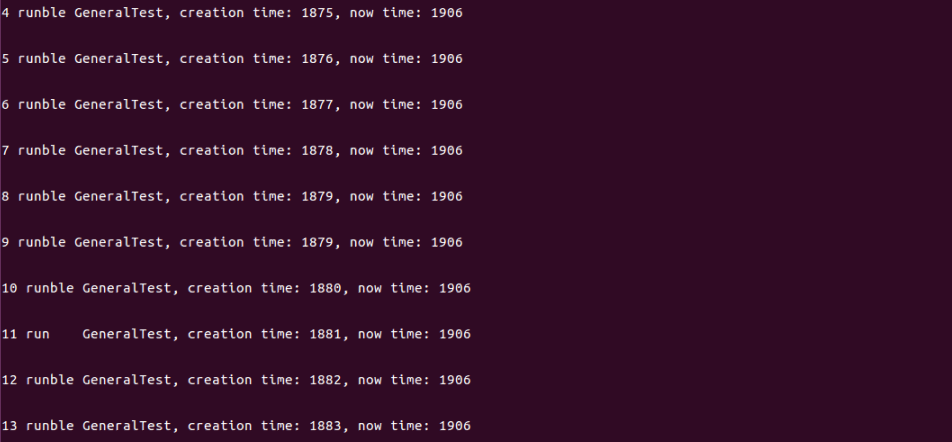
- 再來換pid = 12的process執行
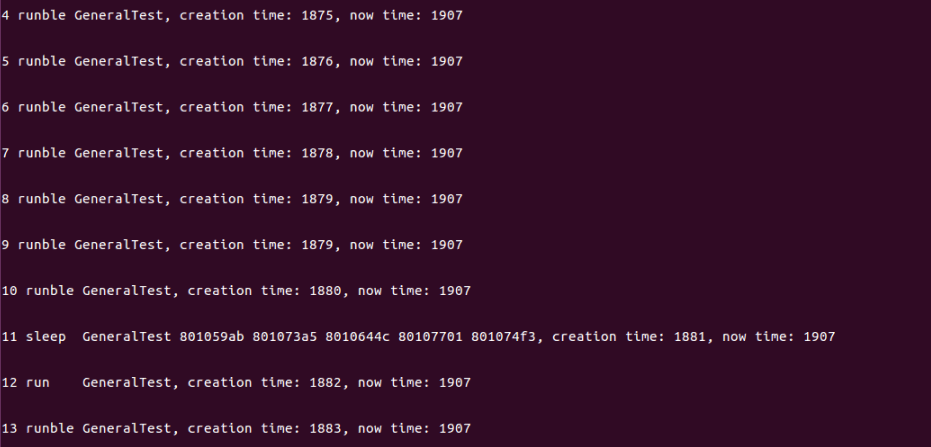
- 再來換pid = 13的process執行
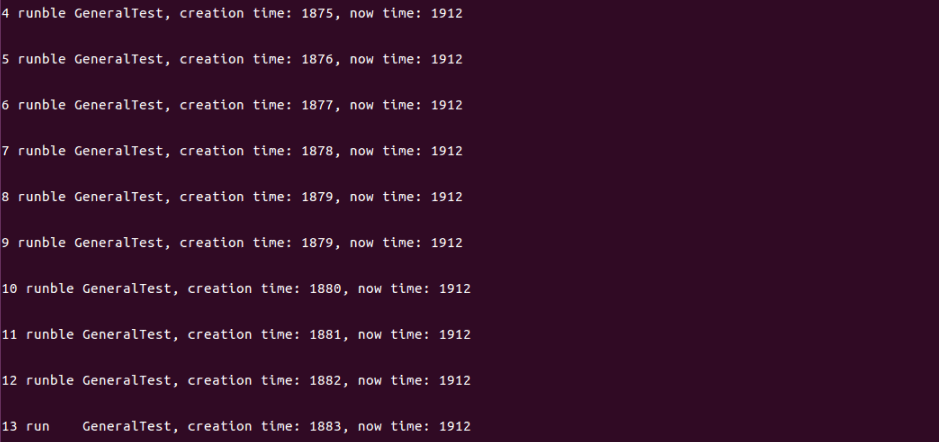
- 因為所有process皆已輪完,故從頭(pid = 4)執行
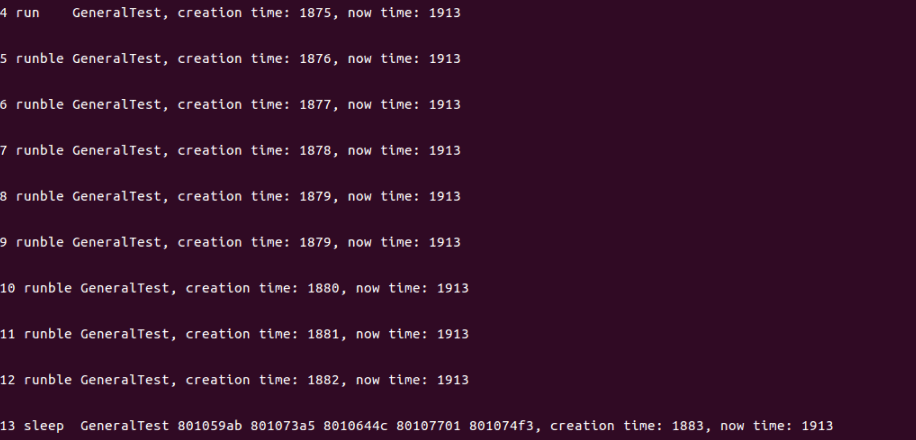
- 輸入GeneralTest測試指令
- First Come First Service (FCFS)
- 輸入GeneralTest測試指令

- allocate出10個process
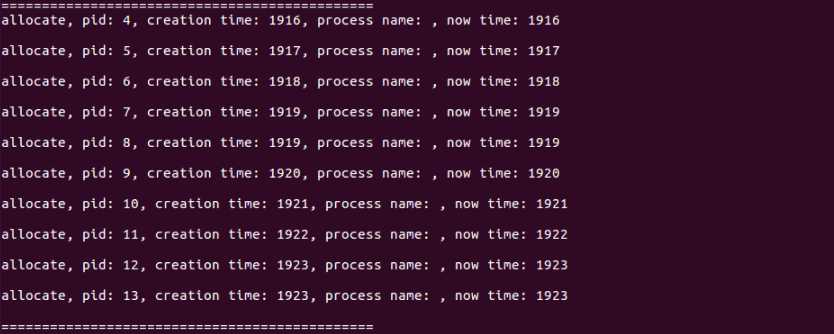
- 4的creation time最小,故最先做
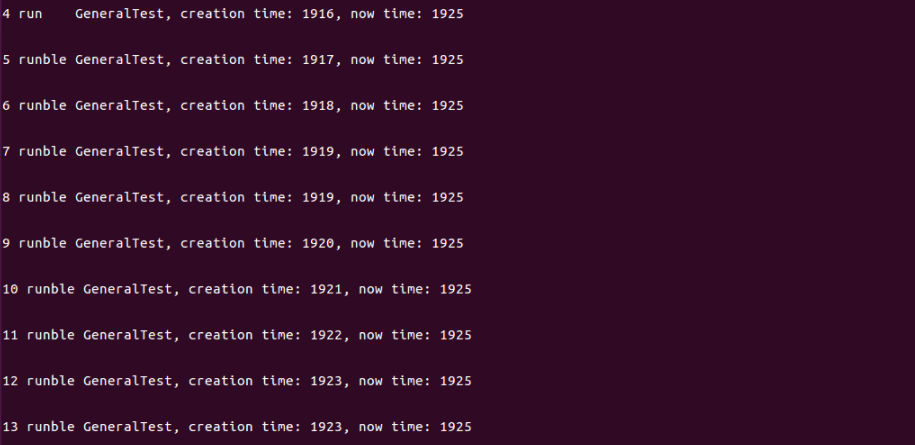
- 其次為pid = 5的process最早,故4做完換5
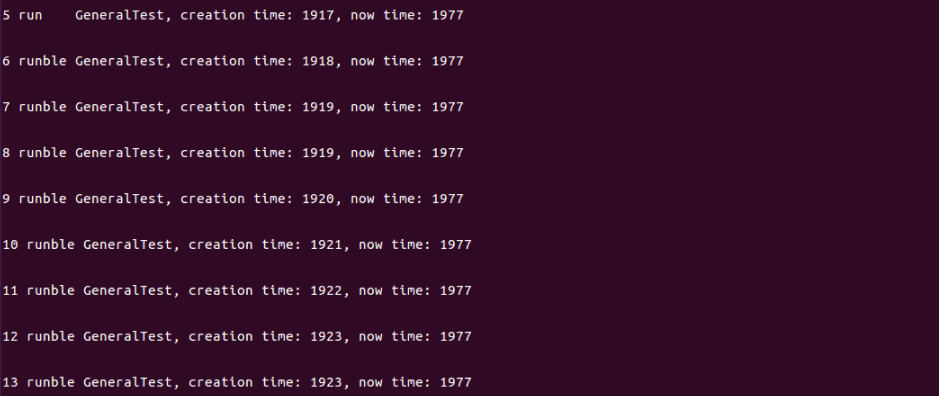
- 再來為pid = 6的process
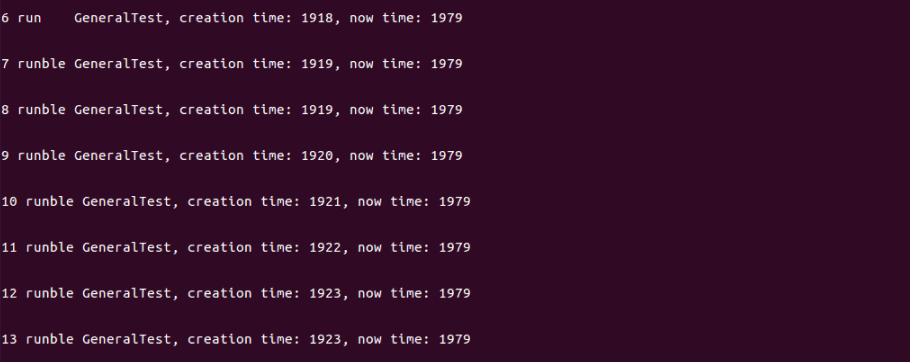
- 再來為pid = 7的process
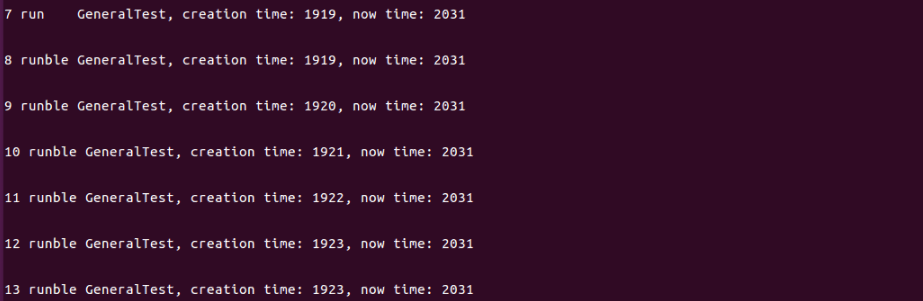
- 再來為pid = 8的process
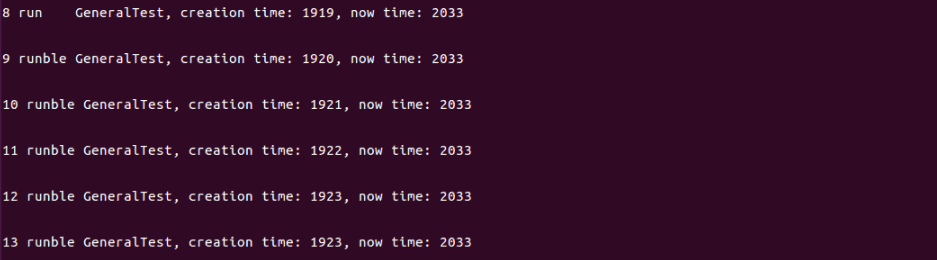
- 再來為pid = 9的process
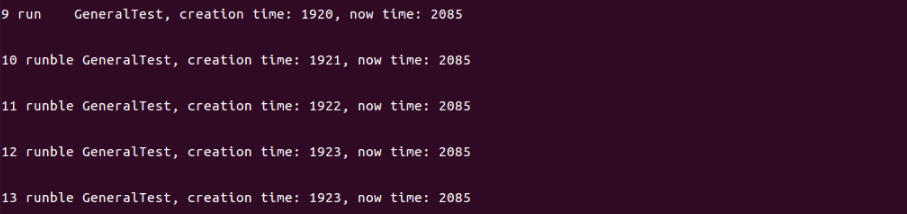
- 再來為pid = 10的process

- 再來為pid = 11的process

- 再來為pid = 12的process

- 再來為pid = 13的process

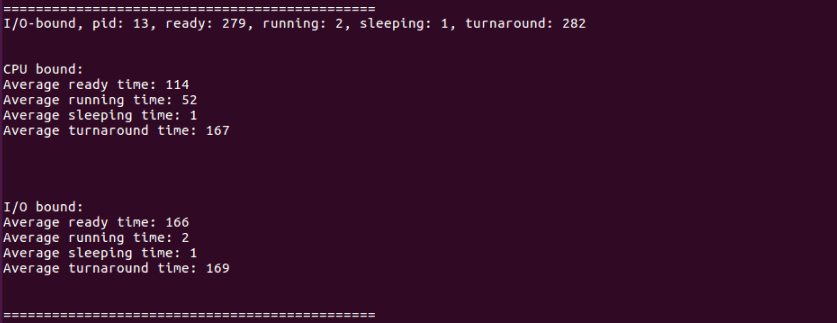
- Print出平均每個 CPU-bound 和 I/O-bound processes的四種時間,分別為
- Ready time
- Running time
- Sleeping time
- Turnaround time
- 輸入GeneralTest測試指令
- Priority
- 輸入GeneralTest指令

- 產生5個process

- 因為所有process的priority一樣,故挑選creation time最小的(pid = 4)
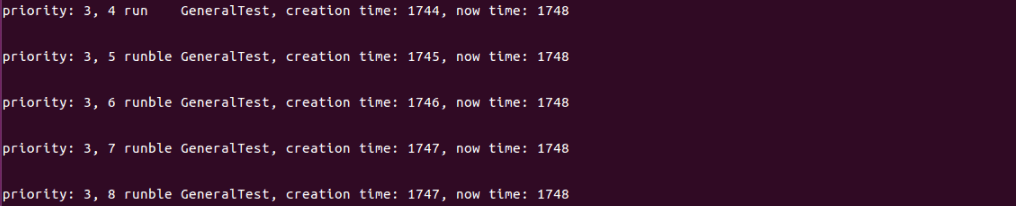
- 再來以pid = 4之process為開頭往後尋找可執行的process,而之後第一個runnable且priority最高者為pid = 5之process,故挑選pid = 5的process執行
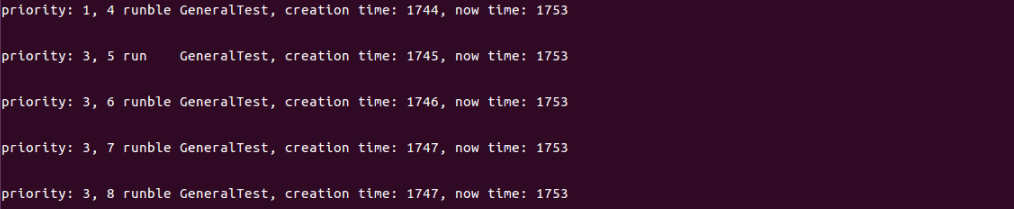
- 再來以pid = 5之process為開頭往後尋找可執行的process,而之後第一個runnable且priority最高者為pid = 6之process,故挑選pid = 6的process執行
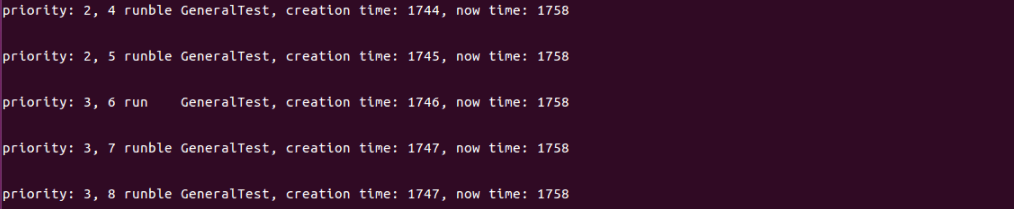
- 再來以pid = 6之process為開頭往後尋找可執行的process,而之後第一個runnable且priority最高者為pid = 7之process,故挑選pid = 7的process執行
- 而此同時有4個process之priority為3,而不能挑選pid = 4 or 5的原因為
- 若挑選pid = 4 or 5,便會造成前三個process無限循環,並導致starvation problem
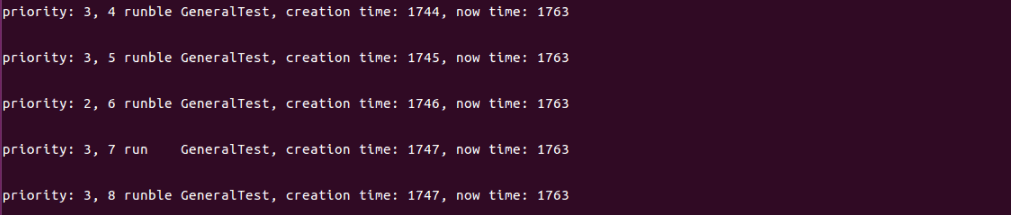
- 若挑選pid = 4 or 5,便會造成前三個process無限循環,並導致starvation problem
- 再來以pid = 7之process為開頭往後尋找可執行的process,而之後第一個runnable且priority最高者為pid = 8之process,故挑選pid = 8的process執行
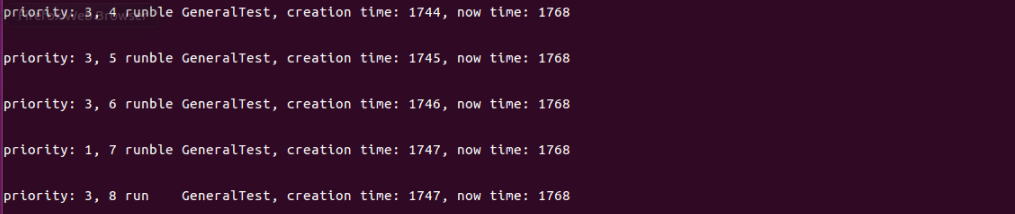
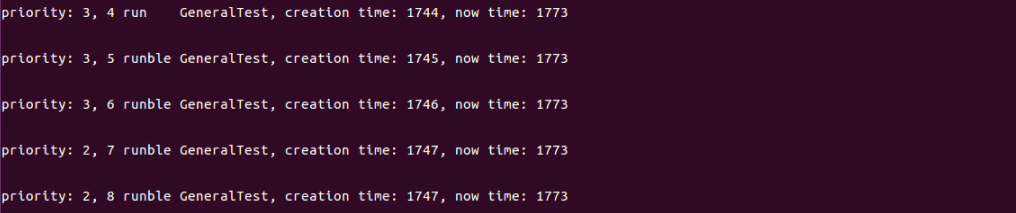
- 再來以pid = 6之process為開頭往後尋找可執行的process,但 因為pid = 8之process以為ptable之最後一個process
- 故從頭開始找,以 最高優先度與state等於runnable的條件 為優先
- 輸入GeneralTest指令
🏃 實作過程(修改哪些檔案[含圖片])
defs.h
- 新增system call至此標頭檔
void scheduler(void) __attribute__((noreturn));
int set_prio(int);
proc.c
- allocproc(void)
- 在process table中allocate一塊空間存放process
static struct proc* allocproc(void)
{
  struct proc *p;
  char *sp;

  acquire(&ptable.lock);
  for(p = ptable.proc; p < &ptable.proc[NPROC]; p++){
    if(p->state == UNUSED){
      break;
    }
  }
  if(p->state!=UNUSED){
    release(&ptable.lock);
    return 0;
  }
  p->state = INIT;
  p->pid = nextpid++;
  p->ctime = ticks;
  p->retime = 0;
  p->rutime = 0;
  p->stime = 0;
  p->fake[0] = '*';
  p->fake[1] = '*';
  p->fake[2] = '*';
  p->fake[3] = '*';
  p->fake[4] = '*';
  p->fake[5] = '*';
  p->fake[6] = '*';
  p->fake[7] = '*';
  release(&ptable.lock);

  // Allocate kernel stack.
  if((p->kstack = kalloc()) == 0){
    p->state = UNUSED;
    return 0;
  }
  sp = p->kstack + KSTACKSIZE;

  // Leave room for trap frame.
  sp -= sizeof *p->tf;
  p->tf = (struct trapframe*)sp;

  // Set up new context to start executing at forkret,
  // which returns to trapret.
  sp -= 4;
  *(uint*)sp = (uint)trapret;

  sp -= sizeof *p->context;
  p->context = (struct context*)sp;
  memset(p->context, 0, sizeof *p->context);
  p->context->eip = (uint)forkret;
  cprintf("allocate, pid: %d, creation time: %d, process name: %s, now time: %d\n\n", p->pid, p->ctime, p->name, ticks);
  return p;
}
- findReadyProcess(int* index1, int* index2, int* index3, uint* priority)
- 用來尋找符合priority之process來執行
#ifdef SML
/*
  this method will find the next process to run
*/
struct proc* findReadyProcess(int *index1, int *index2, int *index3, uint *wantedPriority) {
  int i;
  struct proc* newProc;
while(1){
  for (i = 0; i < NPROC; i++) {
    switch(*wantedPriority) {
      case 1:
        newProc = &ptable.proc[(*index1 + i) % NPROC];
        if (newProc->state == RUNNABLE && newProc->priority == *wantedPriority) {
          *index1 = (*index1 + 1 + i) % NPROC;
          return newProc; // found a runnable process with appropriate priority
        }
      case 2:
        newProc = &ptable.proc[(*index2 + i) % NPROC];
        if (newProc->state == RUNNABLE && newProc->priority == *wantedPriority) {
          *index2 = (*index2 + 1 + i) % NPROC;
          return newProc; // found a runnable process with appropriate priority
        }
      case 3:
        newProc = &ptable.proc[(*index3 + i) % NPROC];
        if (newProc->state == RUNNABLE && newProc->priority == *wantedPriority){
          *index3 = (*index3 + 1 + i) % NPROC;
          return newProc; // found a runnable process with appropriate priority
        }
    }
  }
  if (*wantedPriority == 1) {//did not find any process on any of the prorities
    *wantedPriority = 3;
    return 0;
  }
  else {
    *wantedPriority -= 1; //will try to find a process at a lower priority
    continue;
  }
}
  return 0;
}
#endif
- scheduler(void)
- 根據不同的演算法做process排程
void scheduler(void)
{
  struct proc *p;
  int index1 = 0;
  int index2 = 0;
  int index3 = 0;
  int x = index1;
  index1 = x;
  x = index2;
  index2 = x;
  x = index3;
  index3 = x;

  for(;;){
    // Enable interrupts on this processor.
    sti();

    // Loop over process table looking for process to run.
    acquire(&ptable.lock);


    // the differnt options for scheduling policies, chosen during compilation
    #ifdef DEFAULT//default scheduler round robin

      for(p = ptable.proc; p < &ptable.proc[NPROC]; p++){
       if(p->state != RUNNABLE)
          continue;

      // Switch to chosen process.  It is the process's job
      // to release ptable.lock and then reacquire it
      // before jumping back to us.
        proc = p;
       switchuvm(p);
       //cprintf("RR, pid: %d, creation time: %d, process name: %s, now time: %d\n\n", p->pid, p->ctime, p->name, ticks);
       p->state = RUNNING;
      cprintf("==============================================\n");
      procdump();
      cprintf("==============================================\n");
      //cprintf("\n\n");
      //procdump();
      // cprintf("\n\n");
        swtch(&cpu->scheduler, proc->context);
        switchkvm();
      // cprintf("%d+%s\n",p->pid,p->name);
      // Process is done running for now.
      // It should have changed its p->state before coming back.
        proc = 0;
    }

    #else
    #ifdef FCFS //Scheduler select FCFS
        struct proc *minP = NULL;
        for(p = ptable.proc; p < &ptable.proc[NPROC]; p++){

          if(p->state == RUNNABLE){//check if state is runnable
            if (minP!=NULL){//not a null process

              if(p->ctime < minP->ctime)//find the earlist createtime process
                minP = p;
            }
            else
              minP = p;//first time in loop, set to minp
          }
        }
        if (minP!=NULL){
          p = minP;//the process with the smallest creation time
          proc = p;
          switchuvm(p);
          p->state = RUNNING;
          cprintf("==============================================\n");
          procdump();
          cprintf("==============================================\n");
          swtch(&cpu->scheduler, proc->context);
          switchkvm();
          // Process is done running for now.
          // It should have changed its p->state before coming back.
           proc = 0;
        }

    #else

    #ifdef SML//Scheduler select priority
    uint priority = 3;
    p = findReadyProcess(&index1, &index2, &index3, &priority);
    if (p == 0) {
      release(&ptable.lock);
      continue;
    }
    proc = p;
    switchuvm(p);
    p->state = RUNNING;
    cprintf("==============================================\n");
    procdump();
    cprintf("==============================================\n");
    swtch(&cpu->scheduler, proc->context);
    switchkvm();
    // Deal the starvation problem

    if(p->priority > 2)// let the priority of running process minus 1
      p->priority--;
    // let the priority of non-running process minus 1
    struct proc *temp;
    for(temp = ptable.proc; temp < &ptable.proc[NPROC]; temp++)
    {
      if(temp->pid != p->pid && temp->priority < 3){
        temp->priority++;//add other process's priority
      }
    }
    proc = 0;

    #endif
    #endif
    #endif
    release(&ptable.lock);
  }
}
- updateRecord(void)
- 用來紀錄每個process的runtime、sleeptime、waitingtime
void updateRecord() {
  struct proc *p;
  acquire(&ptable.lock);
  for(p = ptable.proc; p < &ptable.proc[NPROC]; p++){
    switch(p->state) {
      case SLEEPING:
        p->stime++;
        break;
      case RUNNABLE:
        p->retime++;
        break;
      case RUNNING:
        p->rutime++;
        break;
      default:
        ;
    }
  }
  release(&ptable.lock);
}
- set_prio(int priority)
- 用來設定該process之優先度
int set_prio(int priority) {
  if (priority < 1 || priority > 3)
    return -1;
  acquire(&ptable.lock);
  proc->priority = priority;
  release(&ptable.lock);
  return 0;
}
- decpriority(void)
- 用來將該process之優先度減一
void decpriority(void) {
  // acquire(&ptable.lock);
  proc->priority = proc->priority == 1 ? 1 : proc->priority - 1;
  // release(&ptable.lock);
}
proc.h
- 在struct新增幾項用來記錄process相關時間的變數
struct proc {
  char name[16];               // Process name (debugging)
  int pid;                     // Process ID
  uint sz;                     // Size of process memory (bytes)
  pde_t* pgdir;                // Page table
  char *kstack;                // Bottom of kernel stack for this process
  enum procstate state;        // Process state
  struct proc *parent;         // Parent process
  struct trapframe *tf;        // Trap frame for current syscall
  struct context *context;     // swtch() here to run process
  void *chan;                  // If non-zero, sleeping on chan
  int killed;                  // If non-zero, have been killed
  struct file *ofile[NOFILE];  // Open files
  struct inode *cwd;           // Current directory
  uint ctime;                   // Process creation time
  int stime;                   //process SLEEPING time
  int retime;                  //process READY(RUNNABLE) time
  int rutime;                  //process RUNNING time
  int priority;
  int tickcounter;
  char fake[8];
};
GeneralTest.c
- 用來模擬不同類型之process,來測試排程效果
int
main(int argc, char *argv[])
{
	if (argc != 3){
		printf(1, "Usage: GeneralTest <n> <SchedulerType>\n");
		exit();
 	}
	#ifndef SML
	int i;
	int n;
	int j = 0;
	int k;
	int retime;
	int rutime;
	int stime;
	int sums[2][3];
	for (i = 0; i < 2; i++)
		for (j = 0; j < 3; j++)
			sums[i][j] = 0;
	n = atoi(argv[1]);
	i = n; //unimportant
	int pid;
	for (i = 0; i < 2 * n; i++) {
		j = i % 2;
		pid = fork();
		if (pid == 0) {//child
			j = (getpid() - 4) % 2; // ensures independence from the first son's pid when gathering the results in the second part of the program
			switch(j) {
				case 0: //CPU bound process (CPU):
					for (k = 0; k < 100; k++){
						for (j = 0; j < 1000000; j++){}
					}
				case 1:// simulate I/O bound process (IO)
				for(k = 0; k < 1; k++){
					sleep(1);
				}
				break;
			}
			exit(); // children exit here
		}
		continue; // father continues to spawn the next child
	}
	for (i = 0; i < 2 * n; i++) {
		pid = wait2(&retime, &rutime, &stime);
		int res = (pid) % 2; // correlates to j in the dispatching loop
		switch(res) {
			case 0: // CPU bound processes
			printf(1, "CPU-bound, pid: %d, ready: %d, running: %d, sleeping: %d, turnaround: %d\n", pid, retime, rutime, stime, retime + rutime + stime);
			sums[0][0] += retime;
			sums[0][1] += rutime;
			sums[0][2] += stime;
			break;
			case 1: // simulating I/O bound processes
			printf(1, "I/O-bound, pid: %d, ready: %d, running: %d, sleeping: %d, turnaround: %d\n", pid, retime, rutime, stime, retime + rutime + stime);
			sums[1][0] += retime;
			sums[1][1] += rutime;
			sums[1][2] += stime;
		break;
		}
	}
	for (i = 0; i < 2; i++)
		for (j = 0; j < 3; j++)
			sums[i][j] /= n;
	printf(1, "\n\nCPU bound:\nAverage ready time: %d\nAverage running time: %d\nAverage sleeping time: %d\nAverage turnaround time: %d\n\n\n", sums[0][0], sums[0][1], sums[0][2], sums[0][0] + sums[0][1] + sums[0][2]);
	printf(1, "\n\nI/O bound:\nAverage ready time: %d\nAverage running time: %d\nAverage sleeping time: %d\nAverage turnaround time: %d\n\n\n", sums[1][0], sums[1][1], sums[1][2], sums[1][0] + sums[1][1] + sums[1][2]);
	#endif

	#ifdef SML
	int i;
	int n;
	int j = 0;
	int k;
	int retime;
	int rutime;
	int stime;
	int sums[3][3];
	for (i = 0; i < 3; i++)
		for (j = 0; j < 3; j++)
			sums[i][j] = 0;
	n = atoi(argv[1]);
	i = n; //unimportant
	int pid;
	for (i = 0; i < n; i++) {
		j = i % 3;
		pid = fork();
		if (pid == 0) {//child
			j = (getpid() - 4) % 3; // ensures independence from the first son's pid when gathering the results in the second part of the program
			#ifdef SML
			switch(j) {
				case 0:
          			set_prio(1);
					break;
				case 1:
          			set_prio(2);
					break;
				case 2:
         			set_prio(3);
					break;
			}
			#endif
      		for (k = 0; k < 100; k++){
       			for (j = 0; j < 1000000; j++){}
      		}
			for (k = 0; k < 100; k++){
       			for (j = 0; j < 1000000; j++){}
      		}
			for (k = 0; k < 100; k++){
       			for (j = 0; j < 1000000; j++){}
      		}
			for (k = 0; k < 100; k++){
       			for (j = 0; j < 1000000; j++){}
      		}
			for (k = 0; k < 100; k++){
       			for (j = 0; j < 1000000; j++){}
      		}
			exit(); // children exit here
		}
		continue; // father continues to spawn the next child
	}
	for (i = 0; i < 3 * n; i++) {
		pid = wait2(&retime, &rutime, &stime);
		int res = (pid - 4) % 3; // correlates to j in the dispatching loop
		switch(res) {
			case 0: // CPU bound processes
				printf(1, "Priority 1, pid: %d, ready: %d, running: %d, sleeping: %d, turnaround: %d\n", pid, retime, rutime, stime, retime + rutime + stime);
				sums[0][0] += retime;
				sums[0][1] += rutime;
				sums[0][2] += stime;
				break;
			case 1: // CPU bound processes, short tasks
				printf(1, "Priority 2, pid: %d, ready: %d, running: %d, sleeping: %d, turnaround: %d\n", pid, retime, rutime, stime, retime + rutime + stime);
				sums[1][0] += retime;
				sums[1][1] += rutime;
				sums[1][2] += stime;
				break;
			case 2: // simulating I/O bound processes
				printf(1, "Priority 3, pid: %d, ready: %d, running: %d, sleeping: %d, turnaround: %d\n", pid, retime, rutime, stime, retime + rutime + stime);
				sums[2][0] += retime;
				sums[2][1] += rutime;
				sums[2][2] += stime;
				break;
		}
	}
	for (i = 0; i < 3; i++)
		for (j = 0; j < 3; j++)
			sums[i][j] /= n;
 	printf(1, "\n\nPriority 1:\nAverage ready time: %d\nAverage running time: %d\nAverage sleeping time: %d\nAverage turnaround time: %d\n\n\n", sums[0][0], sums[0][1], sums[0][2], sums[0][0] + sums[0][1] + sums[0][2]);
	printf(1, "Priority 2:\nAverage ready time: %d\nAverage running time: %d\nAverage sleeping time: %d\nAverage turnaround time: %d\n\n\n", sums[1][0], sums[1][1], sums[1][2], sums[1][0] + sums[1][1] + sums[1][2]);
	printf(1, "Priority 3:\nAverage ready time: %d\nAverage running time: %d\nAverage sleeping time: %d\nAverage turnaround time: %d\n\n\n", sums[2][0], sums[2][1], sums[2][2], sums[2][0] + sums[2][1] + sums[2][2]);
	#endif
	exit();
}
sh.c
- 印出現在所用之排程方法為何
  printf(1, "Selected scheduling policy: ");
  #ifdef DEFAULT
    printf(1, "Round Robin\n");
  #else
  #ifdef FCFS
    printf(1, "FCFS\n");
  #else
  #ifdef SML
    printf(1, "Priority\n");
  #endif
  #endif
  #endif
syscall.c
- 宣告system call的關聯
extern int sys_set_prio(void);
syscall.h
- 宣告system call的代號
#define SYS_set_prio 24
makefile
- 新增指令進入點
UPROGS=\
	_cat\
	_echo\
	_forktest\
	_grep\
	_init\
	_kill\
	_ln\
	_ls\
	_mkdir\
	_rm\
	_sh\
	_stressfs\
	_usertests\
	_wc\
	_zombie\
	_GeneralTest\
	_PriorityTest\
- 修改qemu需運用到的cpu核心數
ifndef CPUS
CPUS := 1
endif
sysproc.c
- 新增set priority及修改排程方法之system call
int sys_set_prio(void) {
  int priority;
  argint(0, &priority);
  return set_prio(priority);
}
😎 結論
- 每種不同的系統提供 不同的服務,所適合的Schedular也不同 ,應該考慮使用情境之後依據需求挑選Schedular
- 而在實做Schedular時有幾個須注意到的點
- 加入priority時避免Starvation的問題
- Round Robin每次分配到使用CPU的時間長短都是需要依據狀況做調整的
- Schedular在OS中扮演極為重要的角色,一個好的schedular可以讓整個System的運作更加流暢
- 在設計Schedular時須注意到系統可能有好幾個core(Schedular)所以在偵錯時候可能出現結果會和心中所預想的結果不一樣,可以先將虛擬機設定為單核心(Schedular),方便偵錯
📅 組員分工
B10415016 楊璿譯
- 撰寫system call
- 撰寫三種schedular演算法
- 研讀系統source code
B10415039 曾柏誠
- 撰寫test case program
- 資料查詢